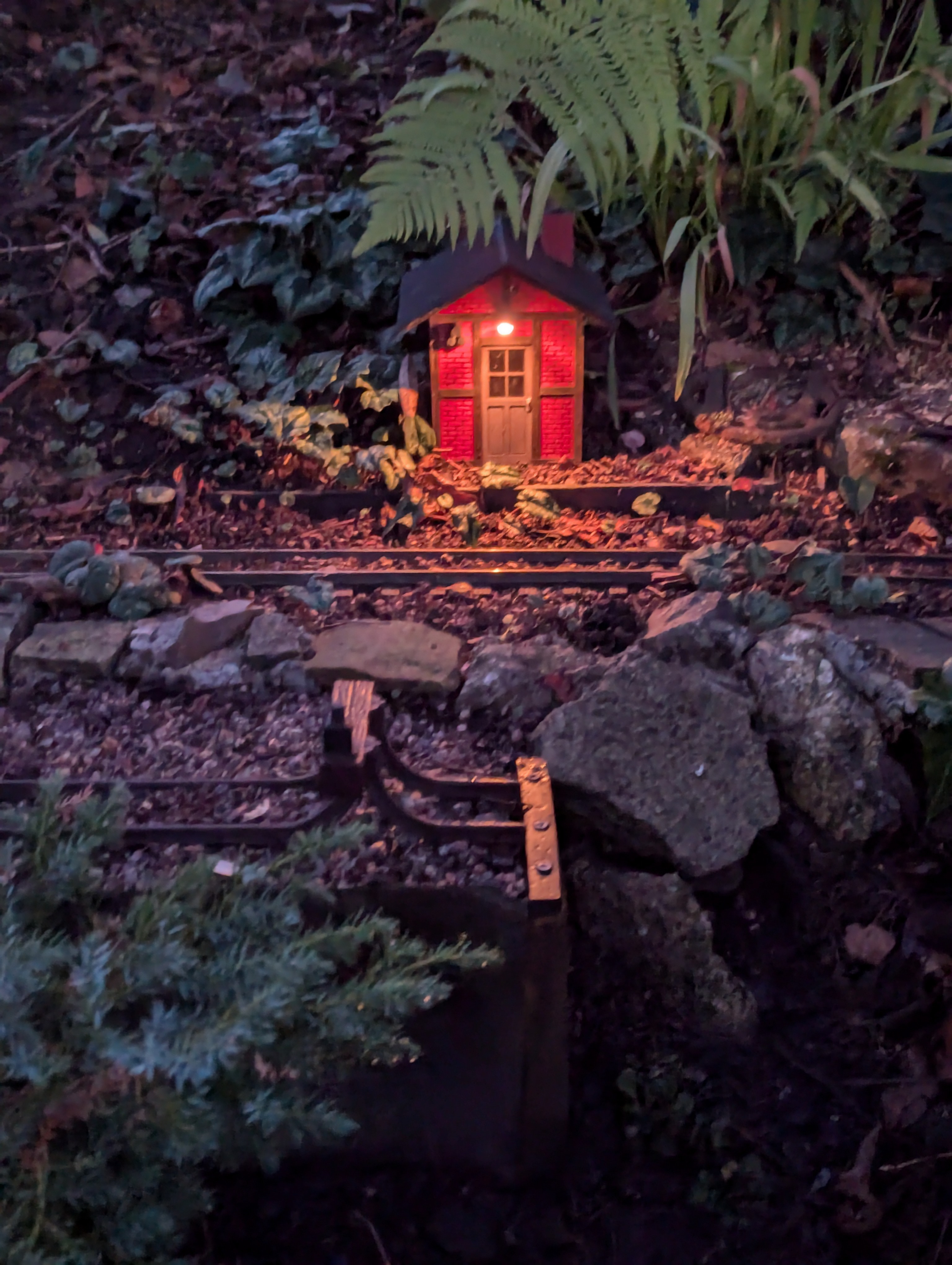
The front face has reverted to slate, which may help to hide a multitude of errors and omissions.

Baseboard repairs seem to be a theme, with work needed at both Dottendorf and Birkenhof. All sorts of under board supports seem to have given up the ghost at Birkenhof, and the General Manager really doesn't have the desire to rip the whole lot up. For the moment we're relying on the efforts of Bodgit & Scaper. Trains can still run...
Long term readers might recall that the H&DLR a couple of Saxon brake vans, built to scale by Herr Hilbert from his kits for me back in 2013 and 2015. I'm very fond of them, but one at least tends to suffer from the axles falling out of the bogies. The axles are long, but the bogie side frames are also set quite far apart - just enough for an axle to drop out occasionally. Finally found a possible solution - adding a few 3mm or 4BA washers to reduce the slop. It took a few washers (but a spare oversize nut was too thick).
And a short video of the two vans under test with a couple of Rollwagen.
...and running repairs. The track was sagging badly on the innermost line at Birkenhof as a cross member supporting the baseboards had failed.
Today saw the Faur festival on the H&DLR, celebrating the arrival of the LGB model of the Faur L45H diesel as operating on the Zittauer Schmalspurbahn in Saxony. In all five Faurs ran, including Paul's model of a slightly different prototype, built from a kit by James Hilton and now resident oh the Linz Gstadt Bahn.
Trains often run here either side of new year, but I don't think anything has run yet this month. Anyway, a beautiful if cold morning made me think that the accumulated leaves and detritus on the track probably should be removed.
Given the sad failure of my Helmsman over the last couple of years, as part of my winterisation preparations, I had taken the new Piko analogue controller indoors, and rigged up an old LGB 1 amp controller - one of the older style monobloc controllers, not the weedy two part one. Although it is capable of powering any of my twin motor locomotives, it won't power my track cleaner. A battery powered train ran first, after which, slightly to my surprise, 2091.03 did get round on track power with only minimal assistance from a track rubber.
I'd been thinking of converting No.5 to "dual fuel", capable of running on track power or battery power, a little like my 2092 shunter. I'm sure that in theory I could do it, but when I opened her up, I lost confidence and decided to go - for now at least - back to straight on track operation. Once I'd got the quartering right, made up a replacement lead weight to replace the battery (the original weights are probably in 399.03) and corrected the short circuit I accidentally created re-assembling the chassis, all was well.
I bought a Helmsman controller in January 2008 after the H&DLR v2 was built. This was upgraded with a radio remote control in 2018 along with a repair to the main controller. Last year it was apparent that there were malfunctions occurring with the Helmsman that have become more persistent this year. There's a significant voltage swing around 6v, which is the starting voltage for many locomotives, and which is likely to damage the onboard electronics on newer models. Additionally, from time to time, when the speed is set back down to zero, the locomotive continues to run. This tends to result in a mad dash into the shed to switch the power off at the mains. Disappointingly, Peco, who inherited the Helmsman business, state that they cannot repair the G Scale controllers as they don't have the parts.
I therefore bought an analogue Piko 35002 controller and their 35000 5A transformer, which is an absolute brick of a thing and can be used with their digital controller as well. The controller has proved to be very smooth and effective.
The next stage in the evolution of the system is to add a remote control. This can be done by adding the Piko radio receiver, which can control the analogue controller, and a handheld navigator. The latter is, of course, designed to be used with a digital control system and using it on analogue is somewhat overkill. Nevertheless, it works, and who knows what the future might hold. Given that all LGB locomotives are now digital with sound, it would make sense to be able to manage and control those additional functions especially since LGB's approach to analogue functionality can best be described as "we couldn't care less".
Maintenance on a garden railway is a near constant task. A little while ago, some Belli-Beco lamps were installed. I'd have to say that the design is somewhat sub optimal for outdoor use, as one wire relies on loosely touching a metal sleeve to provide electrical continuity. Over the years this has often proved troublesome, and one lamp failed completely recently. Obviously, this was on the building with a sealed base... anyway, the dremel cut into it, and a new bulb was installed. We'll see how well this lasts, but here it is for now.
On what would have been Gillian's 65th birthday, there really was only one train that could run - the Orient Express set that she asked for as her 40th birthday present.
With the rebuild complete, minor repairs and upgrades have continued, and trains have been running.
Gradual progress is being made, with Holzapfel restored to the network, albeit with further work required.
With the long viaduct completed, attention has turned to some work at Birkenhof. Additional battens to raise the height of the front edge have been installed, providing a better ballast retainer. In one area, a small "rock armour" section of larger stones was used to block a gap.One light at Birkenhof has been repaired, but sadly another, rather nice, lamp has suffered probably from the blackbirds and is unlikely to be restorable.